ALL FEATURES | ALL FULL ISSUES | ISSUE 32
Originally published on November 22, 2026 in issue 32 of Forward Weekly
Only a year ago, it seemed inconceivable that the Alberta NDP could form the next government. Polls consistently showed the UCP leading by as much as double digits. Now the parties are neck and neck.
All things considered, the party performed decently in the 2023 election, with 44 percent of the popular vote, a higher voter share than when it formed government in 2015. Sources within the party say its leadership is confident it will perform even better in 2027. The strategy is to present itself as a competent, scandal-free government-in-waiting, ready to govern after populist anger inevitably consumes the UCP.
This strategy appeared to have borne some fruit in a September by-election, when frustration over the UCP’s risky referendum gambit seemingly handed over a safe UCP seat to the NDP. Calgary-Shaw was precisely the type of suburban Calgary riding the NDP must flip in the next election. And all signs show the flipping has begun. According to Poliwave’s aggregate, if the election were held today, the NDP would form a 45-seat majority.
Enter Alberta’s newly proposed electoral boundary maps introduced in the legislature on Nov. 16 and passed first reading. Should Bill 40 become law, it could narrow the NDP’s path to victory by attaching UCP-friendly rural areas to swing ridings in Lethbridge and northwest Calgary.
Bill 40 revives a version of the “rurban” model proposed in a minority report last year by two UCP-appointed members of the Electoral Boundaries Commission, which commission chair Dallas Miller, a retired judge, called “unconstitutional.” Others used a different word — “gerrymandering” — referring to the partisan electoral redistricting common in the U.S., in which politicians attempt to spread their opponents’ support as thinly as possible across the electoral map while concentrating it in as few districts as possible.
But this is more than a partisan advantage — it’s a democratic imbalance. The proposed map would dilute some Albertans' voting power simply because of where they live.
While the advisory panel’s version of the map isn’t as aggressively partisan as the minority report, it reconfigures the boundaries just enough to give the UCP an advantage, even if the next election is closer than the last. And, says University of Alberta political scientist Feo Snagovsky, it sets a dangerous precedent, even if its outcome doesn’t go as far as the misshapen districts associated with U.S.-style redistricting. “American gerrymandering is like champagne from the Champagne Region. It’s the finest in the world,” says Snagovsky. Alberta’s is more like prosecco, but it’s “definitely enough to tilt the balance of an election.”
For example, Minister of Assisted Living and Community Supports Nathan Neudorf won his election in Lethbridge-East by 2.9 percentage points. But according to Fair Maps, an interactive tool by Public Interest Alberta illustrating how the 2023 election results would have played out with the panel’s proposed boundaries in place, Neudorf would have won the newly hybridized riding of Lethbridge-Little Bow by 25 percentage points.
Data scientist John Santos of Janet Brown Opinion Research says many of the proposed hybrid ridings combine reliably UCP-leaning rural voters with more “fickle” NDP-leaning urban voters. That gives the UCP an inherent advantage that may not be reflected in the raw demographics.
Take the proposed Calgary-Bow-Springbank riding, for instance. Had it existed in 2023 Education Minister Demetrios Nicolaides would have won by 5.7 percentage points, according to Fair Maps data, but under the current riding, which excludes the roughly 5,000 residents of Springbank, Nicolaides won by just 1.5 percentage points. Similarly, the proposed Calgary-North West-Bearspaw riding would have increased Indigenous Relations Minister Rajan Sawhney’s margin from a razor-thin 0.6 percentage points to 1.6.
But this is more than a partisan advantage — it’s a democratic imbalance. The proposed map would dilute some Albertans’ voting power simply because of where they live. “Eight people within the Calgary and Edmonton ridings would get the same representation in the legislature as seven people outside the big cities,” explains independent data strategist Robson Fletcher. In other words, a ballot cast in Alberta’s two biggest cities is worth 0.88 of the weight of a vote cast elsewhere.
So what’s an opposition party to do?
Leader Naheed Nenshi has already promised a court challenge of the proposed boundaries, which could result in a court-imposed electoral map months before the next election. But, says Santos, rather than depend on the courts to force a fair electoral map, the NDP “just have to organize better and stockpile more votes in the friendly parts of those ridings to overcome the addition of the other parts that have been lumped in.”
The NDP’s surprise Calgary-Shaw victory suggests to Santos that the New Democrats have already “improved their mobilization and organizational infrastructure.” He adds, “That's really the only way that they can fight this.”
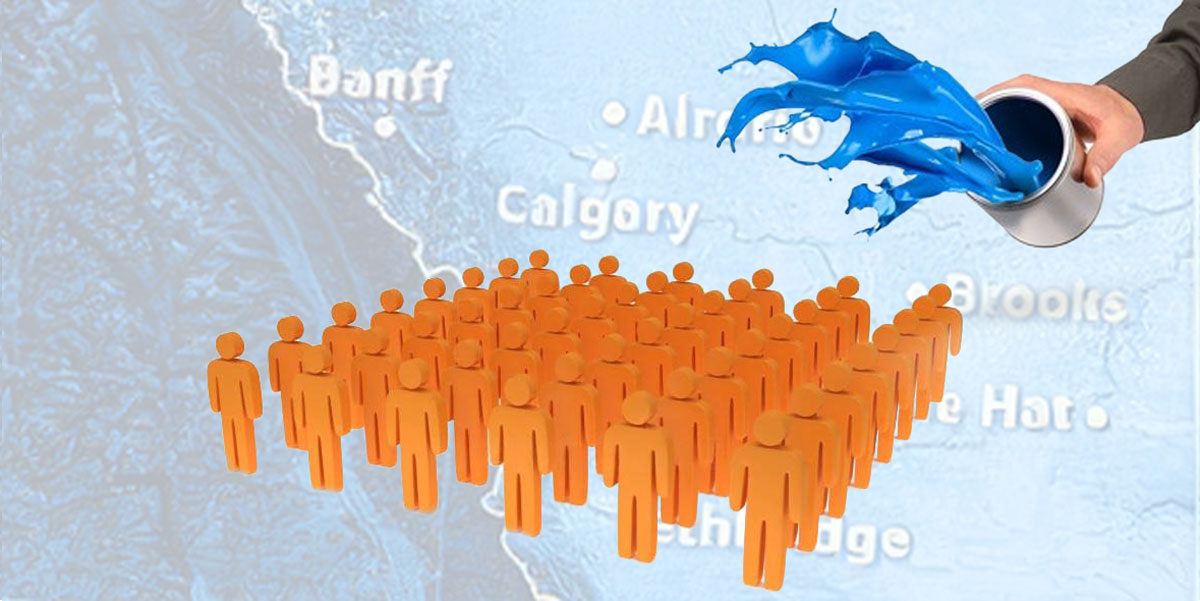
Former Lethbridge-West NDP MLA Shannon Phillips knows what it takes to paint a previously conservative riding orange. She says the proposal to divide Lethbridge among four ridings would make it “impossible” for the NDP to win more than one of them “unless something just absolutely massive changes.”
The new Calgary boundaries, she says, are less of an obstacle for party candidates — so long as they make their presence known. By that, she means identifying pockets of persuadable voters and tailoring a message to them. “Go talk to people, figure out what they want. Try to deliver it,” she said. “Presence is persuasion.”
Controversy over redistricting could itself contribute to the public’s exasperation with the UCP, which has been central to the NDP’s electoral strategy. Fletcher conducted polling in May 2026 with Manitoba-based firm Probe Research that showed more than 60 percent of Albertans thought that the premier was redrawing boundaries so that she could win the next election and that city ridings shouldn’t expand beyond city limits. “They already had a pretty cynical view of the motivations for doing it,” says Fletcher.
There’s also a recent example of gerrymandering efforts backfiring in a state that had mastered it for decades. Earlier this month, Republicans captured just one of the five Democratic seats targeted by their new Texas map — and lost two of their own. The Democratic wave in the 2026 U.S. midterms shows how broader shifts in voter behaviour can overcome gerrymandering, Snagovsky explained.
“Gerrymandering is not impossible to overcome,” he said. “It's just difficult.”
Jeremy Appel is an Edmonton-based journalist and author of Dark Phoenix: The Rise, Fall, and Re-emergence of Danielle Smith. He writes The Orchard newsletter, and his work has appeared in the New York Times, the Globe and Mail, Maclean’s and elsewhere.
A note from Forward Weekly on opinion content: The opinions expressed in this feature article are solely those of the author and do not necessarily reflect the views of Forward Weekly or its publisher, editors, staff, or affiliates.