ALL FEATURES | ALL FULL ISSUES | ISSUE 11
Originally published on June 7, 2026 in issue 11 of Forward Weekly
Since 2021, Edmonton police have patrolled the inner city in vehicles branded with the colourful letters HELP — or Human-centred Engagement and Liaison Partnership. Instead of a second constable in the passenger seat, HELP Unit drivers travel alongside service navigators from local nonprofits who help provide essential resources and services to vulnerable residents. “We have given community members a monthly bus pass so they could attend appointments because transportation was their major barrier,” Sgt. Kellie Morgan told Alberta Native News after its launch. “Other citizens received assistance completing forms to obtain pension, housing, medical care, or even obtaining identification because they didn’t know who could help them or where to go.”
At its founding, the police chief touted HELP as an innovative way for the city to tell Edmonton’s most vulnerable people “they matter.” The creation of the team was one part of a larger nationwide shift in policing.
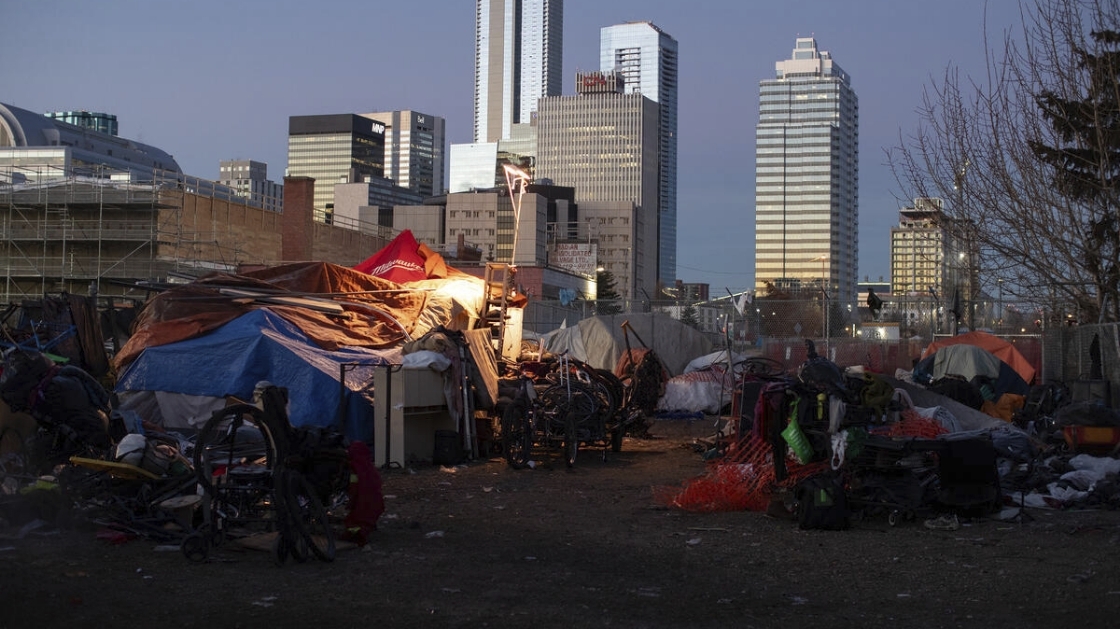
Inspired by the compassion that spread in the indirect wreckage of the COVID-19 pandemic — surging unemployment, drug overdoses and homelessness, as well as the social justice protests of the moment — police across Canada were beginning to embrace a more humane approach. But since then Alberta’s policing services have begun to return to an enforcement-centric model, and Edmonton’s police service is no exception.
EPS will soon launch a revamped version of its HELP Unit. According to City News, HELP will be reoriented towards what’s known in law enforcement as “focused interventions.” Police Chief Warren Driechel told City News that this reimagining of the HELP team was prompted not by EPS itself, but by changes to provincial grants that mandate the team function as part of the province’s “compassionate care” framework.
When the changes officially take effect on July 1, police will have expanded authority to detain people who have not been accused or convicted of a crime.
I have spent years working in Alberta's human services sector, supporting individuals and families experiencing poverty and homelessness. Colleagues across the sector — including some who work directly with the HELP team — tell me these changes are already underway. Sources within HELP's partner agencies, who requested anonymity, say they once led interactions with community members but are now expected to follow the police constable's lead. What’s more, HELP's role appears to be narrowing. Where the unit once helped people secure housing and access long-term medical care, it is now largely limited to same-day interventions. According to two community workers, HELP will no longer offer case management services or resource distribution, and that even the colourful HELP vehicles will soon be replaced with standard EPS-branded vehicles.
When the changes officially take effect on July 1, police will have expanded authority to detain people who have not been accused or convicted of a crime. Depending on the circumstances, those detentions could be carried out under legislation such as the Compassionate Intervention Act or the Mental Health Act. As Chief Driechel told City News, “We can use some of those temporary holding powers to hold them.”
One of the places HELP detainees will be brought is EPS’s new Integrated Stabilization Centre, which is set to open later this year. There, they’ll be assessed and, if those assessments turn out a certain way, transferred to mental health or recovery treatment facilities for extended periods. Involuntary detention without charge can last for months under the Compassionate Intervention Act.
Regardless of the moral and judicial complications, the theory of change at play here is fundamentally misguided. At a time when our housing system is pushing people into homelessness and our health system is so inadequate that people are reduced to managing their trauma with fentanyl — the notion that we can detain our way out of these problems is a fantasy.
And yet, this carceral approach has become the trend across the province.
Over the past year Calgary Police Service has cracked down on the city’s unhoused communities. Last winter, CPS launched three operations — including one around the holidays callously named Operation Jingle All the Way — where over 100 uniformed officers were tasked with confronting unhoused citizens. They destroyed their belongings and issued various citations and arrests. The most draconian sweep, named Operation Order, was described by one former city councillor as “a military-style exercise that swept through downtown in force, marching in line and flanked by officers on horseback.” Calgary’s dramatic sweeps have been reproduced in Alberta’s smaller municipalities as well; Lethbridge and Red Deer have both had similar operations in recent months.
The community response to these sweeps has been mixed. While many residents and business owners undoubtedly feel safer, others, including Calgary Downtown Association director Mark Garner, worry they're a short-term fix that fails to address the underlying causes of homelessness. “Enforcement is one component,” he told Livewire Calgary, “but I’m more interested in enforcement wraparound services and making sure that the work done today continues on to get people off the street and get them into the help that they need.”
The notion that we can detain our way out of these problems is a fantasy.
Garner’s intuition about the long-term effectiveness of these kinds of police operations is backed up by the people who study these interventions. Research from the University of California, Berkeley shows that “abatements” like Operation Order do little to reduce overall levels of homelessness. What they do accomplish is displacement: pushing vulnerable people farther from essential services, destroying personal belongings and eroding trust between police and communities. The consequences can be severe. People experiencing homelessness are already among those most likely to be victims of violent crime, and studies suggest these interventions can leave them at even greater risk of harm. Ultimately, law enforcement will never be able to punish people into prosperity.
These manpower-intensive maneuvers are ineffective at dealing with the challenges posed by a society like ours that produces homelessness at scale — and they’re incredibly expensive. While CPS does not publish financial reports for individual operations, the organization did push to increase their annual budget by 13 percent to an eye-watering $613 million, making it the city’s single largest expense at 18 percent of Calgary’s operating budget. Yet despite the widespread community’s ambivalent response, the undoubtedly high costs and the likelihood of negative long-term outcomes, Calgary Police Chief Katie McLellan committed to more blitz-style operations going forward.
These sweeps are often done in partnership with provincial sheriffs and under the oversight of a police commission appointed, in part, by the province. It can be argued that Calgary and Edmonton’s return to carceral justice is an extension of the Government of Alberta’s attempt to exert greater control over municipalities — the most infamous example being Bill 20, which gave provincial cabinet members authority to overturn laws and even fire elected city officials. Policing, particularly the policing of vulnerable communities, has emerged as a significant site of this political tug-of-war. This environment of influence peddling has resulted in the increasing politicization of Alberta’s police services. Leaked documents suggest several prominent police chiefs helped organize institutional support for the UCP during election campaigns.
It might be tempting to describe Alberta’s approach as the criminalization of poverty, but this pithy descriptor misses the point. Our unhoused friends and neighbours are not being accused of crimes or brought before representatives of the justice system. They are being swept out of the way not because they have broken any laws (even arbitrary ones created for the purpose of sweeping them away), they are being swept away simply because this province’s powerbrokers wish it to be so.
On the terrain of ideology and power, little things like cost, efficacy, and outcomes cease to matter.
Editor's Note: James Hardwick is the pen name of a senior staff member at an Alberta inner-city service organization. Forward Weekly has verified the author's identity and professional background, and is satisfied that he has the experience and firsthand knowledge to write authoritatively about the issues discussed in this essay.
James Hardwick is a pen name. The author is a community advocate with more than 10 years’ experience serving adults experiencing poverty and houselessness with various NGOs across the country.
A note from Forward Weekly on opinion content: The opinions expressed in this feature article are solely those of the author and do not necessarily reflect the views of Forward Weekly or its publisher, editors, staff, or affiliates.