ALL FEATURES | ALL FULL ISSUES | ISSUE 23
You’ve likely seen the polls: Support for separation across the province is declining. In June, Ipsos found that just 19 percent of Albertans say they would vote for the option to hold a future binding referendum on separation. Meanwhile, the independence movement has been hobbled by various controversies, both legal and ideological.
It’s easy to get the impression that this whole debacle has been a waste of time — an irksome attempt by Premier Danielle Smith and the UCP to pander to a noisy fringe so they can keep their jobs.
All of that might be true. But the polls don’t show the whole picture. And, as the saying goes, complacency is the enemy of progress.
The separatists are clearly a minority, but they’re a highly mobilized minority that will show up to the referendum in droves. A good chunk of those who want to stay in Canada, meanwhile, will probably stay home.
It’s going to take an overwhelming loss to make this idea go away.
That sets the stage for a much slimmer result than the public opinion polls predict, the result of which could embolden the separatists for a generation to come. Even if it doesn’t trigger an immediate independence referendum, a solid showing by the separatists will effectively entrench their movement in Alberta’s political mainstream.
“For those people who want this conversation to end, it's going to be really important that they show up to vote,” says Lisa Young, a political science professor at the University of Calgary. “It’s going to take an overwhelming loss to make this idea go away.”
So, exactly how much of a landslide would be required to humiliate the separatists and push them back into obscurity?
According to Young, 35 percent in favour of a future referendum on separation “is about as high as it can go without becoming uncomfortable. … If we start getting close to 40 percent, that will give real life to the separatist movement.” She adds, “At that point, they just need to convince an extra 10 percent of the electorate to get the conditions in place for a win.”
Young is also concerned about what will happen in the weeks following the referendum if the separation vote is not definitively rejected — claims that the votes were miscounted, that mail-in ballots were fake or some other MAGA-inspired allegations of a “rigged” vote.
“I suspect that we’ll spend way too much time talking about allegations of election fraud, coming from both sides of the 49th parallel,” she says.
In Alberta, voter turnout for federal and provincial elections usually hovers around 60 percent.
These elections employ the first-past-the-post electoral system, in which the province is broken into regional ridings that each elect one representative. But most ridings in the province are not particularly competitive, especially in rural areas, where conservative candidates typically dominate. This creates the conditions for political apathy. Voters might choose to stay home because the result in their riding feels like a foregone conclusion.
When it comes to the Oct. 19 referendums, however, there are no ridings, and there is no first-past-the-post system. Every vote will carry the same weight, whether you’re in an orange neighbourhood in Edmonton or a blue riding in Tofield.
If people who want to stay in Canada don't show up to vote, it's going to look closer than it really is.
That means the so-called rural Alberta advantage, which benefits conservative politicians, is off the table. But it also means that voter apathy will work in the favour of the separatists — and they are well aware of this. In early August, the disgraced (but still influential) secessionist David Parker — he of the Centurion Project fiasco — posted a prediction on X:
“Alberta Independence will get between 30–40% on the referendum question if turnout is above 60%. If turnout is below 50%, there is a very good chance we will win. If turnout is as low as the equalization referendum was (40%), it will be a super majority.”
Though it reeks of exaggeration, the takeaway is crystal clear.
“If people who want to stay in Canada don't show up to vote, it's going to look closer than it really is,” says Young. “Which means that we're going to have to do this all over again next spring.”
The same logic applies to the five questions about immigration — questions that, as we’ve noted before, not only risk doing great harm to Alberta’s temporary residents, but appear to be lifted straight from the separatist playbook. Worryingly, recent polling shows that the majority of Albertans plan to vote yes on the immigration questions. That means it’s not enough for progressive voters to just turn out in droves; they also have the added responsibility of educating their pro-unity friends and family about the serious dangers posed by the other questions that they will be tasked with answering.
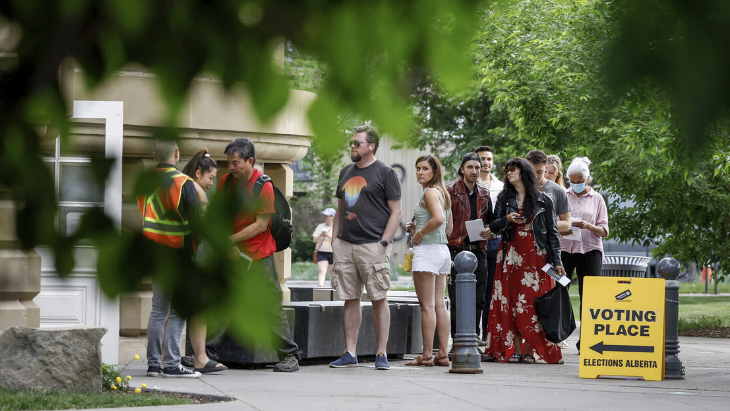
Voting on referendum day will be far more complicated and time-consuming than a general election.
On Oct. 19, each voter will be tasked with answering 10 referendum questions. Each question will be printed on a different, colour-coded piece of paper, and placed into a corresponding box. These questions, as we’ve explored previously, are complicated, confusing and occasionally contradictory.
If someone is against the separatists, but there’s a big lineup outside of the junior high (ballot station), they might say ‘Oh well, not a big deal; the separatists aren’t going to win.’
Elections Alberta recently performed a series of simulations and found that the process will take an estimated two to five minutes per voter. “Not only has Alberta never done anything like this, nowhere in Canada has anything like this been done before,” Dallas Stoesz, deputy chief electoral officer for Elections Alberta, told CBC News.
This creates the potential for disaster on referendum day, according to Young, who notes that Elections Alberta is already soliciting help from electoral bodies in the other provinces to help support the process. “When you think through the logistics of filling out 10 different ballots that all need to make it into the correct box, this risks causing big lineups,” she explains. “If someone is against the separatists, but there’s a big lineup outside of the junior high (ballot station), they might say ‘Oh well, not a big deal; the separatists aren’t going to win.’”
That’s not a great outcome if the goal is high voter turnout, she says.
To counter this risk, Young says pro-unity supporters should consider requesting special mail-in ballots, which allow Albertans to vote in advance and avoid long lines on referendum day. (Following recent changes to the Elections Act, voters no longer have to provide a reason why they want to vote in advance.) In fact, it seems many Albertans are already creating the conditions for a smoother referendum. As of Aug. 26, Elections Alberta has received more than 175,000 requests for special ballots, nearly triple the number requested for the 2023 provincial election.
From the first election of Donald Trump to Brexit, there are plenty of recent examples of unlikely electoral victories, and of underdogs that capitalized on voter apathy to win an election or to gain political legitimacy.
Quebec offers a warning: once separation enters the political mainstream, it can dominate public life for decades
In 1980, a province-wide independence referendum called by the Parti Québécois was rejected, though over 40 percent of the province voted in favour. That was enough to keep the separatist conversation alive and well for another 15 years, when a second referendum was narrowly rejected by just over one percent. And though the movement was ultimately unsuccessful, Quebec’s economy suffered dramatically because of it. In the 1970s, Montreal rivalled Toronto as Canada’s financial capital. Following the 1980 referendum, many businesses headquartered in Montreal packed up and left for Toronto, never to return.
For Alberta, Young says, Quebec offers a warning: once separation enters the political mainstream, it can dominate public life for decades, crowding out nearly every other debate. “This won’t end with one referendum unless the outcome is really definitive.”
Richie Assaly is a freelance journalist and former culture reporter for the Toronto Star. He writes about politics, music and internet culture.
A note from Forward Weekly on opinion content: The opinions expressed in this feature article are solely those of the author and do not necessarily reflect the views of Forward Weekly or its publisher, editors, staff, or affiliates.