ALL FEATURES | ALL FULL ISSUES | ISSUE 17
Throughout the spring, political machinations, complex court challenges and other separatist shenanigans dominated the headlines. Once the dust settled, Albertans were left with a confusing compromise — a referendum on whether to hold a referendum at a later date — that seems to have angered or annoyed folks of every stripe and political leaning.
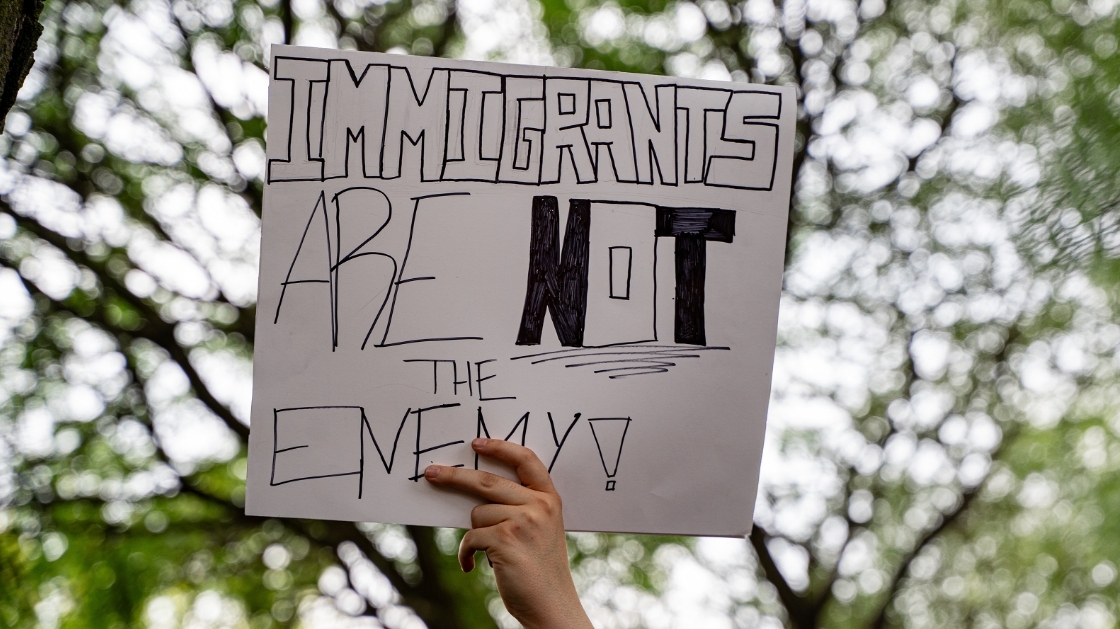
But independence isn’t the only referendum question that Albertans will be voting on this fall. The Oct. 19 ballot will also include five questions centred on immigration in the province that critics say have been designed to demonize newcomers and immigrants by painting them as a threat to the province’s economic prosperity.
If Albertans vote in favour of these questions, the province’s temporary foreign workers and non-permanent residents could lose access to health care, education and other provincially funded services, or be forced to pay additional fees to access them — despite the fact that most of these residents pay taxes like any other resident.
In recent weeks, legal experts, community leaders and professional organizations, including the Alberta Teachers’ Association, have stated their opposition to these questions, and warned of the dangers they pose to immigrant communities.
If passed, these questions will not only hand a win to Alberta separatists — for whom anti-immigration is a major plank of their movement — but they also risk normalizing the kind of reactionary, dog-whistle politics that we’re used to seeing in the U.S. under President Donald Trump.
“The way things are going, there are going to be people showing up on Oct. 19 asking, ‘Why do I have these 10 ballots? I'm here to vote on separation.'”
This is a big deal, though you wouldn’t know it from watching the news, reading mainstream newspapers or scrolling through social media, says Duane Bratt, a professor of political science at Mount Royal University. Bratt, who has been touring the province speaking about the referendum ballot, says that even politically engaged Albertans are preoccupied with the separation question and largely unaware of the high-stakes immigration questions.
“Separation is a big, existential issue, and it has swallowed all of the political oxygen in the province,” he explains. “The way things are going, there are going to be people showing up on Oct. 19 asking, ‘Why do I have these 10 ballots? I'm here to vote on separation.’”
That raises the question: With less than 90 days until the referendum, do Albertans know what they’re walking into? Will the high drama of the independence movement act as a smokescreen for the UCP to push the province in a starkly anti-immigrant direction?
The referendum questions on immigration are based on the results of the Alberta Next Panel, an advisory committee chaired by Premier Danielle Smith that toured the province last year.
Specifically, the questions will ask Albertans to weigh in on whether the province should assume more control over immigration, whether non-permanent residents of Alberta should be able to access social programs such as health care and education, and whether Albertans should have to show proof of citizenship before voting in an election.
On the surface, these may seem like reasonable, straightforward questions. But the way they are being framed for voters, Bratt points out, is misleading and manipulative.
“These questions are repetitive, they contradict each other, and you need a lot of background information to answer them properly”
For example, on the official website for the referendum, the immigration questions are prefaced by noting that an estimated 600,000 people have migrated to Alberta in the past five years.
What it fails to note is that this statistic includes the massive waves of people who migrate to Alberta from other provinces within Canada each month (according to Statistics Canada, Alberta has led the country in interprovincial migration for the last three years). It also fails to note that immigration to Canada has declined in recent months due to federal policies aimed at slowing population growth.
Failing to provide this vital context, Bratt notes, makes voters susceptible to a distorted understanding of immigration and its impacts in Alberta. (The government website also notes that youth unemployment in Alberta is 15.6 percent, implying without evidence that this statistic stems from immigration.)
“These questions are repetitive, they contradict each other, and you need a lot of background information to answer them properly,” says Bratt. He worries that voters, rather than do their homework, might simply treat the ballot questions like a referendum on the government: “If they like the UCP, they will vote yes on all the questions, and if they don’t they will vote no on all of them.”
Bradley Lafortune, executive director of the non-profit advocacy group Public Interest Alberta, believes the five immigration questions are rooted in the assumption that immigrants are to blame for Alberta’s woes — an assumption he calls “absolutely false.”
“The government of Alberta has not provided any evidence that the drivers of the province’s debt and deficit, or the cost of public services, are attributable to high levels of immigration,” Lafortune explains.
For example, the three questions about whether non-permanent residents — refugees, temporary foreign workers and international students — should have access to provincially funded social services, insinuate that these residents are getting a free ride.
Lafortune says this framing clearly obfuscates the fact that the vast majority of non-permanent residents, like citizens, contribute to the provincial coffers through employment and property taxes.
“We've seen this type of framing in other jurisdictions, whether it's in the U.S. or in Western Europe,” he says. “And what it comes down to, from our perspective, is distracting voters from real issues and real solutions.”
With support for Alberta independence declining in recent months, it’s unlikely that the referendum question on separation will pass.
But separatists are not only concerned with secession and equalization, or pipelines, says Bratt, who has been closely following the movement’s evolution. “A large plank of their argument is about cultural values — guns, gender and immigration.”
Unlike mainstream conservative politicians — such as Danielle Smith and Pierre Poilievre, who typically frame their complaints about immigration in terms of school crowding or emergency wait times — the anti-immigrant sentiment among separatists is more extreme, and is often rooted in racist or conspiratorial ideologies.
There is still time for Albertans to wake up and realize just what’s at stake.
For example, Mitch Sylvestre, a key figure in the Alberta independence movement, has seemingly embraced the racist conspiracy known as the “Great Replacement Theory,” and has falsely claimed that former prime minister Justin Trudeau wanted to replace “old stock” white Canadians with immigrants. Kathy Flett, a separatist involved in the Alberta Prosperity Project, has suggested that the federal government is pushing a "jihadist extremist population” onto Canada.
“When people in Red Deer are standing up at events and saying ‘Red Deer does not look the way it did when I was a kid,’ are they talking about class sizes? No, they are talking about minorities,” Bratt says.
By scapegoating immigrants, the UCP is potentially playing into this separatist sentiment, and emboldening the type of anti-immigrant rhetoric that Canadians have largely rejected.
“Are we going to be checking citizenship in emergency wards?” Bratt asks. “Are school teachers going to have to kick out children if they're not an ‘approved Alberta immigrant’? A mother who fled to Canada from Ukraine with her three kids — she can't put her kids in school?”
Lafortune, for his part, believes that there is still time for Albertans to wake up and realize just what’s at stake.
“We don't think that Albertans with the right information would actually support punishing students and families for trying to access health care and education because of issues with respect to status,” he says.
Richie Assaly is a freelance journalist and former culture reporter for the Toronto Star. He writes about politics, music and internet culture. He’s also a juror for Polaris Music Prize.
A note from Forward Weekly on opinion content: The opinions expressed in this feature article are solely those of the author and do not necessarily reflect the views of Forward Weekly or its publisher, editors, staff, or affiliates.