ALL FEATURES | ALL FULL ISSUES | ISSUE 29
Originally published on October 25, 2026 in issue 29 of Forward Weekly
The results on Question 10 are in, and they tell us pretty much what the polls had repeatedly told us for the past year: only about 25 percent of Albertans would actually consider leaving Canada. The campaigns changed little in the end, except the temperature between us. Tens of millions of dollars and volunteer hours spent on both sides of the issue, just to make us angrier at one another.
A few weeks before the referendum, already suspecting that this division was at least partly manufactured, I set out to better understand the feelings and experiences of our separatist neighbours. Even in Ritchie, my neighbourhood in the orange Edmonton–Strathcona riding, I didn’t have to look far to find them.
How could this lovely older couple be supporters of a movement I find so obviously misguided and destructive?
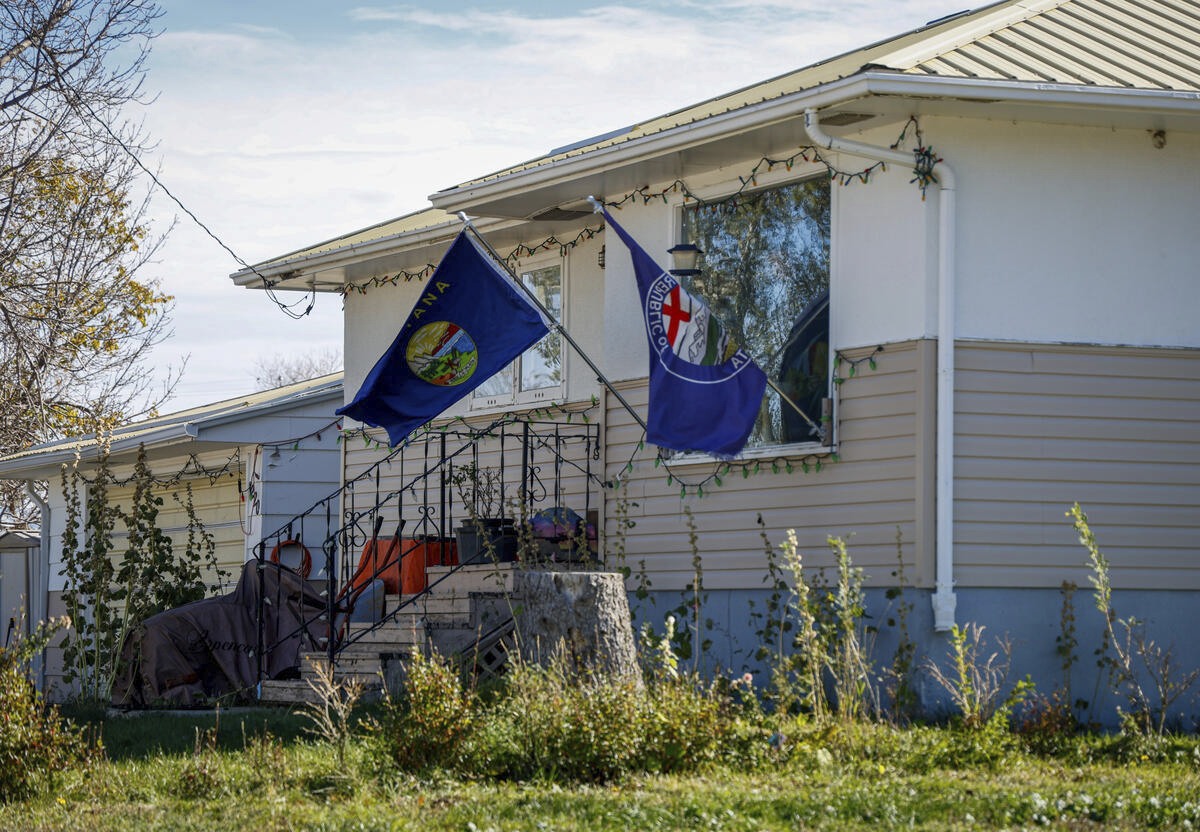
Ever since I moved here, I’ve been running into Carl and Peggy on the off-leash trails. They are always accompanied by a little white dog — first Sassy and then her successor Suzie — and they always stop to chat. Despite Ritchie’s self-proclaimed reputation for friendliness, for years I considered Carl and Peggy, who live a couple of blocks away from me, my closest neighbours. Three Thanksgivings ago, I borrowed a pie plate from them on 15 minutes’ notice. This year, I was surprised to see a huge blue Alberta flag and a cluster of independence signs appear in their front yard. How could this lovely older couple be supporters of a movement I find so obviously misguided and destructive?
I decided to ask them. One note dropped in their mailbox and a few trail run-ins later, they agreed to an interview. Though Carl and Peggy seemed genuinely eager to talk with me, the social stakes were high.
We chatted over video call, which felt safer, I think, than having coffee in person. Carl and Peggy have lived in Ritchie for 20 years, but, since putting their lawn signs up, are still being shunned by their neighbours.
“I don’t think a lot of people who talk about independence really want independence. They want to say, ‘Look at us, we want a change, so that we have representation in Ottawa.’”
After complimenting each other’s blue kitchens, we got into it; the first thing they wanted me to know is that they aren’t separatists, exactly. In fact, they love Canada in their own way. Peggy recalled growing up: “When I would hear them sing ‘O Canada’ I almost felt like crying. For years and years I felt that way.” Carl added, “I don’t think a lot of people who talk about independence really want independence. They want to say, ‘Look at us, we want a change, so that we have representation in Ottawa.’”
One of Peggy’s main grievances is the apparent futility of voting in a western Canadian riding. It was only minutes into our conversation when she mentioned how it felt, tracking the results of the most recent federal election. “We had just closed our voting, and they were already calling it!” I experienced an unexpected frisson of recognition. I have experienced this outrage too, though I’ve never held onto it for long. Maybe the difference is that I’ve never expected much of the federal government.
As we continued talking, I was struck by the impression that Carl and Peggy know more about federal policy decisions than I do, even if I don’t agree with their interpretation of what bills like C-8 and C-11 mean.
For her part, Peggy is also deeply upset that people in Alberta are queuing at the food bank while she keeps coming across news articles about the foreign aid that Canada dispenses. “We wanted them to take care of the people here, not give it away to everybody,” she said, bluntly. I am not opposed to foreign aid (though I would prefer it didn’t go hand in hand with weapons supply), but I have never actually expected the Canadian government to “take care” of its citizens. The reason CERB seemed like a miracle to me (and oh boy, as a freelancer, it did) was that it was such a surprise.
As we continued talking, I was struck by the impression that Carl and Peggy know more about federal policy decisions than I do, even if I don’t agree with their interpretation of what bills like C-8 and C-11 mean. My despair over the Canadian government has translated into apathy, while Carl and Peggy are eager to process up-to-the-minute information, and fired up about the intersection of Albertan issues with larger dynamics within the country as a whole.
Like many supporters of Albertan independence, they see Alberta’s oil and gas industry as financially propping up the rest of Canada, even as it is throttled by federal regulations.
This is something I was curious about: the separatist focus on high taxes and government “interference,” rather than unchecked corporate power and a monopolized energy industry.
I asked: “Do you envision an ideal situation in which oil and gas money would be shared more directly with Albertans? For instance, via dividend payments or a federal trust as in countries that have nationalized their energy industries?” They nodded. “Yes.”
Wow. A nationalized energy industry? That’s a utopia even self-described socialists like me aren’t daring to talk about, much less actively campaign to realize. While I don’t believe that an independent Alberta would in fact distribute wealth in this way, Carl and Peggy are right to ask why anyone is queuing at the food bank (or waiting for surgery, or sending their child to learn in an overcrowded classroom) in a province with such significant natural resources.
I think what Peggy means by “communistic” is closer to what I would call “authoritarian” or “fascist.” She, like me, is afraid of losing her personal freedoms to a violent state.
I asked if it was fair to say that Carl and Peggy’s dissatisfactions boil down to economics. Not quite. “It’s control,” Carl said. He is concerned about the aforementioned bills, which he sees as attacks on freedom of speech and information. Peggy chimed in. “It’s getting too communistic.”
There’s an opportunity for a gotcha moment here with regard to the nationalization of industry, but I’m not interested in linguistic entrapment. I think what Peggy means by “communistic” is closer to what I would call “authoritarian” or “fascist.” She, like me, is afraid of losing her personal freedoms to a violent state. Describing coverage of the trucker convoy in 2022, Peggy remembers, “I was watching it live. And they sent down the guys on the horses, and they ran over that . . . I was standing there bawling my eyes out the whole day.”
Regardless of whether or not any members of the trucker convoy were inappropriately treated by the RCMP, and regardless of the amount of sympathy I’m able to drum up for those truckers, I believe Carl and Peggy’s general fears are grounded. We do live in a country — a world, really — where individuals are being constantly surveilled through their internet use, where the government hasn’t done enough to protect individual freedoms from being compromised by invasive technologies and powerful companies. And we do live in a country where you can suffer from state-sanctioned violence — for the crime of not being able to pay your rent; for being obviously racialized; for, yes, protesting in the wrong way.
As proudly as I poked my “Stay In Canada / No To The Nine” sign into my lawn, it now seems undeniable how insufficient this kind of rhetoric is when it comes to addressing the fears and concerns that might prompt an ordinary Albertan to jump on the separatist bandwagon.
When the subject of my sign came up, Peggy said, “There will be no changes. Saying no to everything says we’re happy with everything the way that it is.” She saw the “No to the nine” slogan as an acquiescence to the status quo, and as an attempt to discourage people from thinking for themselves.
Carl: “If people would really sit and look at the questions, they might vote differently than they would after hearing someone say ‘Go in and vote no on everything’.”
Filling in my mail-in ballots after speaking with Carl and Peggy, I did in fact reconsider the senate question. Why did I still vote no? Honestly, because I distrust Danielle Smith, full stop, and don’t believe that anything her office suggests could possibly be good for anyone. Perhaps I am part of the problem. I did not feel I had enough information, the right, or, frankly, the motivation to engage with a process of reorganization on a federal level.
In Alberta, the left has been reactive, defensive, uninspired. We have fought with and mocked and feared and reviled the “other side.”
But there are consequences to my alienation from Ottawa that feel increasingly urgent to consider. Do I see Mark Carney’s government addressing our obscenely elevated cost of living, our housing crisis, our climate crisis? No. Do I see Truth and Reconciliation progressing? No. Do I feel represented by a Canadian government that continues to economically support an actively genocidal state? No. Do I see a direct, democratic route by which I, together with other people who believe similarly, could prompt timely change on any of these fronts? Also no. Do I feel I am represented? That’s a complicated question. As much as I admire my MP, Heather McPherson, and support the arguments she makes in parliament, I’m not delusional about the clout the NDP has on a federal level.
In Alberta, the left has been reactive, defensive, uninspired. We have fought with and mocked and feared and reviled the “other side.” We have left the issues-defining and question-asking up to a government that used the threat of separation as a tactic to distract voters into sanctioning legislation that — even while we remain a part of Canada — will bring our province that much closer to the spectre of an ultra-conservative Albertan state that has been haunting us so-called progressives all year.
We need to ask better questions, and propose more audacious and creative solutions. We need to do more than defend the status quo. If separation isn’t the answer, we had better come up with a more compelling one — together.
Lizzie Derksen is a writer and filmmaker from Treaty 6 Territory. Shy Woman, her documentary about women's friendships, is streaming now on CBC Gem.
A note from Forward Weekly on opinion content: The opinions expressed in this feature article are solely those of the author and do not necessarily reflect the views of Forward Weekly or its publisher, editors, staff, or affiliates.