ALL FEATURES | ALL FULL ISSUES | ISSUE 22
Illustrations by Eric Dyck
Originally published on September 6, 2026 in issue 22 of Forward Weekly
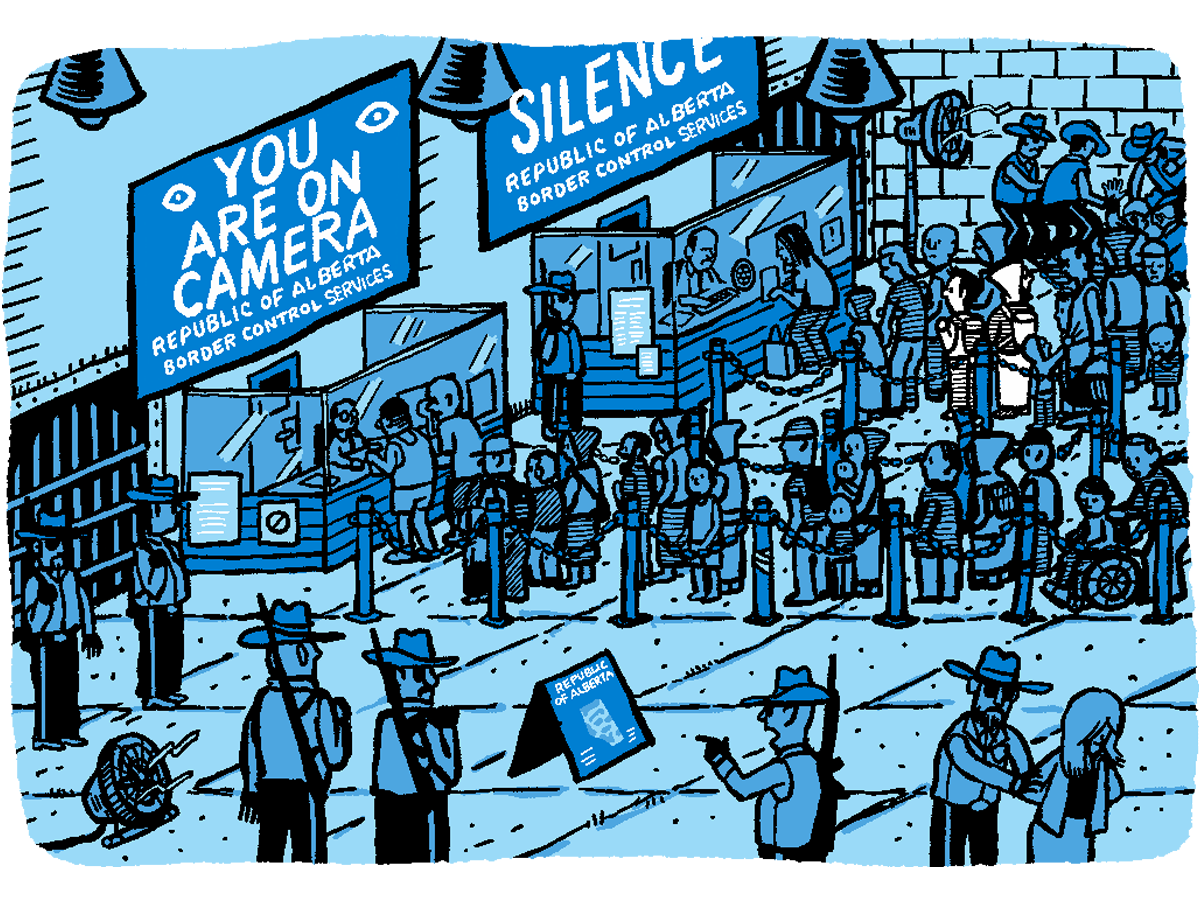
Under the large signs reading SILENCE and YOU ARE ON CAMERA four guards are beating an old man, without invective or indeed commentary of any kind. From her position near the wall, Ashlyn can hear the man’s muffled yelps and the thud! thud! of the plastic correctors. Now and then she gets a glimpse of a hunched form, dark on the pale floor, grey hair gleaming occasionally between the legs of the crowd. But mostly she just sees the guards.
When it’s over, silence descends once more, or at least the muted hum of a great number of people packed into a high-ceilinged, concrete room, everyone aware that the guards might come over for a shout, but whispers are generally overlooked.
"What did he do?" she asks Tanner, who is two years younger and about a foot taller than her.
"I don't know," he whispers back. "I didn't see."
Behind him, a small woman in a smothering straw bonnet tilts her head to deflect the sound, and says, "He pulled his scarf up. Right over his mouth and nose."
Ashlyn chuckles reflexively, and ignores Tanner's cluck—this is, or was, their mother's sound of polite exasperation, meant to indicate: You knew better than that. The Republic of Alberta Anti-Masking Regulation (Part IV of the Sovereignty Code, Section 59, clauses 3-10) is older than she is, and anyway, the air inside the border admin building is cleaner than outside—not much, but there are fans going. Really, he was causing trouble for nothing.
"Senile," Tanner says. "I bet they're taking him to Alberta Health right now."
Ashlyn nods, half-listening. The guards are going along the far wall, their bright blue uniforms unmistakeable against the concrete, and they seem to be carrying something—maybe it's the old man, maybe not. They vanish into a door marked EMPLOYEES ONLY before Ashlyn can say for sure. Would they euthanize him right now? Can they? When they came to put down Granddad last winter, the family was given four weeks’ notice. But the rules are probably different in here.
For one thing, the loudspeakers outside, proclaiming various changes to the regulations every few minutes, are absent inside the border facility. Hidden speakers continue to notify the waiting crowd of what they need to know, but with the echo it's so garbled she can't understand it any more. Sometimes a phrase or number will emerge all alone:
your possessions
remain in
Section One Hundred And
ensure
Ashlyn glances down-line at the patient mass of people confined within the maze of lightweight chains and stanchions, her eyes swimming with exhaustion. "The line moves quicker than you think," someone had said outside, and she had scoffed back then, two days ago. But it was true; under the smoke and the haze, bathed in the close-up roar of the Freedom Centres that made sleep impossible, it had felt like they would never get in here, but here they were. You just had to be patient, and trust that the staff were working as hard as they could.
"You can let go," Tanner says softly, and Ashlyn starts. She hadn't realized she was clutching his sleeve, possibly his forearm underneath it, so hard that her knuckles are gleaming white through their light coat of dirt.
"Sorry."
"They were just doing their job," he adds.
"I'm fine," she says. "It wasn't that. I... I'm just tired, that's all."
But she's shaking, and a moment later finds herself oddly relieved at another distraction: a ragged wail, perhaps twenty yards away. A baby? No, it's an adult, a woman, swathed in a multicoloured shawl that seems to be impeding whatever she's trying to do, her hands tangling in it.
"Who? Who was it?" she shouts.
People have been whispering since the line moved inside the building; her racket rattles against Ashlyn's ears with physical force. No one is replying to the woman—everyone is turning away from her—and a couple of guards are drifting over, big young guys, their hands up, not reaching for corrective items just yet.
The woman's voice rises, falls, eventually subsides as they manage to calm her down, and then one of them is escorting her out, lifting the chains over her head and prodding her towards the door, despite her protests, back to where the line stretches into the orange-lit distance.
Ashlyn waits for the news to make it up-line, and is not disappointed when the straw-bonneted woman murmurs, "Says somebody stole her ID. She had it five minutes ago, inside her clothes, and now it's gone."
"Oh, how awful," Tanner says politely. Ashlyn spins her own waxed-canvas bag from back to front and starts fumbling frantically with the buckles, snaps, straps, and zipper.
"Ash," he sighs. "Come on. You know—"
"Just making sure." They can't get this wrong, they can't skip even a single document, or they too will be kicked out, and they just... they just can't, there's no time.
But everything seems to be where she put it, tucked into the folders and still clipped together. Identification, birth certificates, certificates of residency, residency certificates (not the same thing—the registry office had been quite nasty about that), death certificates, background checks, criminal record checks, money for the administrative fees, and a wad of extra cash, squirreled away in a tiny pocket right against her back, because her best friend's cousin had told her more might be needed for bribes.
How much more?
I dunno. But take some, or you'll never make it across.
That's ridiculous. With all those people watching. How do you think anyone's gonna miss seeing a bribe?
Everybody knows it, Ash. Don't be naïve.
She fastens everything back up and takes a deep breath, turning to face forward again. They're nearly at the front now, the hum of the crowd drowned out by yet more fans, clunky old-style beasts scattered around the floor, their heads turning slowly back and forth to dissipate the accumulating body heat.
A chest-high wall of blue-painted concrete rises from the floor, pierced at intervals by an arched metal gate and the border agent in front of it, each of them indistinctly juggling screens and paper forms behind cloudy plastic shields. The faded WE DID IT! logos stencilled on the wall are still visible under the much newer REPUBLIC OF ALBERTA - BORDER SERVICES signs. A few of the booths have maps of the Republic, the familiar shapes of freedom squeezed and pinched between the long-ago petulance of legal challenges and Indigenous territories.
Behind the blue-painted wall is a nondescript stretch of the same concrete flooring, burnished to a rough matte by the passage of uncountable feet. On its far side — perhaps 10 or 15 paces — is another string of plastic-enclosed booths, strung along nothing more than a yellow line painted on the floor. Two of the oddly aggressive-looking Canadian flags are suspended from metal holders on either side of what her eyes and mind insist must be a gate, but is just empty space, half a hallway with the booths filling the other half. The WELCOME TO CANADA/BIENVENUE AU CANADA makes her stomach flip, though she can't tell by this point whether that's anticipation, anxiety, hunger, or something else.
"Next!"
She hasn't been paying attention; the guard has spoken nearly into her ear, and she jumps, grabbing Tanner's elbow again. He looks down at her, the familiar blue eyes shaded under his hat—his expression, she suspects, much like her own: I'm not ready!
We can do this, she thinks. We don't need a grownup. We're the grownups now.
Their border agent is waving them over. Ashlyn follows Tanner to the booth, where a middle-aged man with black-framed spectacles and thinning, ginger hair makes a point of frowning at them, but otherwise remains stark still. "Purpose of departure permit?" he says, pursing his lips.
There's specific wording for this; you can't just say visiting family or financial assistance, even if both are true in this case, because they'll deny the permit without looking at anything else. She says, carefully: "In-person legal requirement."
The agent grimaces. Fine. "Duration of request?"
"Fourteen days."
This visibly seems to mollify him—fourteen days in enemy territory isn't so bad. Not bad enough to really, you know, ruin someone. Probably not enough time to get into serious trouble and cause some kind of diplomatic incident.
He pulls up the permit on his screen. "Identification," he says.
There's a little lip built into the exterior of the booth; Ashlyn balances her bag on it and brings out documents one by one as the agent demands each to review, scan and copy, before entering its information into his form.
"Fingerprints," he drones, and Tanner offers his hand first, then she offers hers—a moment of startling revulsion as her fingers sink into a blob of cold gel, rather than the ink pad she had been expecting.
"Legal requirement."
Ashlyn doesn't think she's hesitated, but clearly she has. Tanner pats her shoulder, putting some weight into it, as if he's reassuring a spooked dog. "Our mother passed away in June," she says quietly, removing the last envelope from its folder. "Here's the death certificate … there are three minor children still at home. We —"
"Says here five minors."
Her throat is tightening up. They rehearsed this at home, in the carriage, in the line. All the words are there if she can just get them past the stone of grief threatening to steal her voice. "Spencer and Colten passed away last year," she says. "Measles. Their death certificates are clipped to the back. Our father..." She can't quite manage abandoned, even though everyone said it was the best word to use. If you were abandoned children then you were demonstrating self-sufficiency by taking action, and crossing permits were supposed to reward that.
"... lives in Canada," she says, just before the agent starts speaking again. "And is offering... an amount of financial aid... specifically for the minor children. But for identification confirmation we have to come in person. There's a letter from the lawyer."
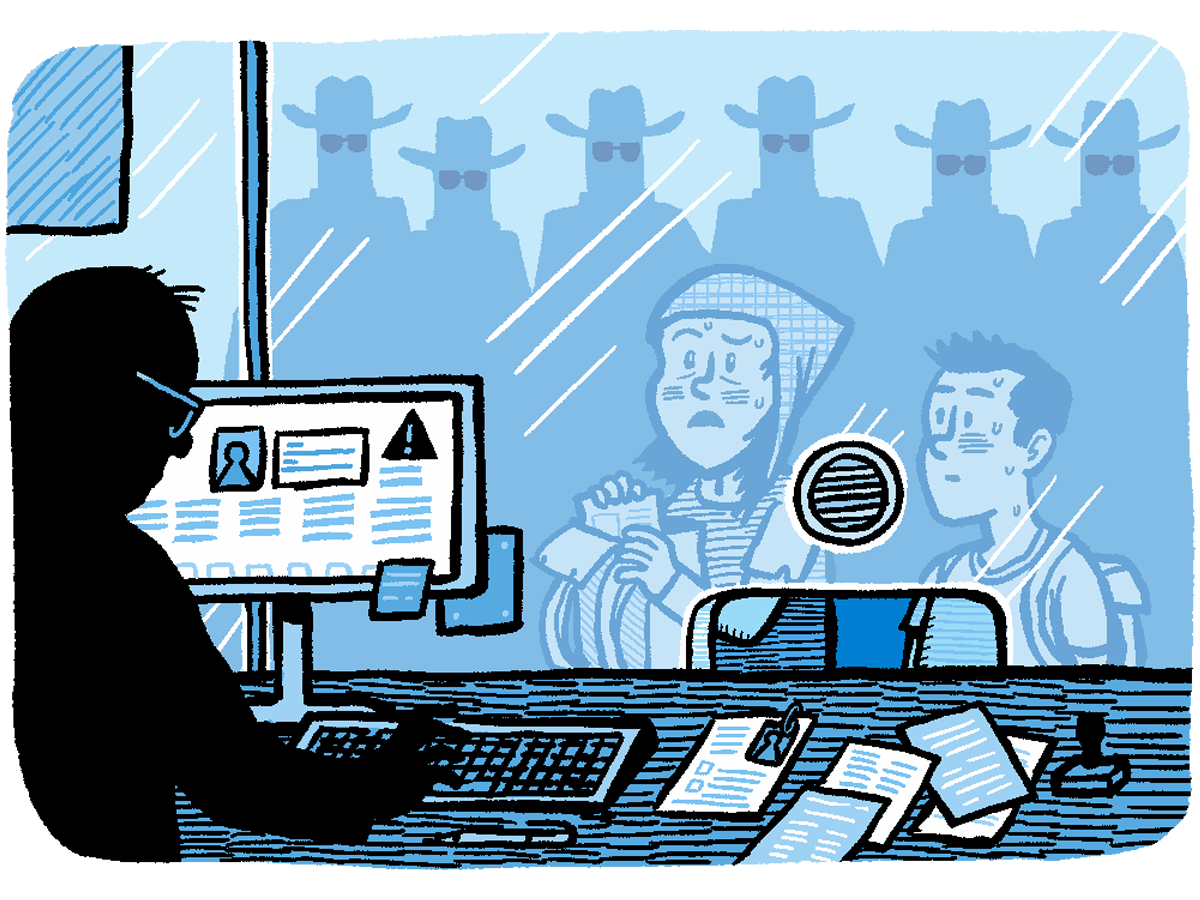
The agent accepts the envelope as if it's lightly coated in slime, and spends far too long poring over the letter—single-spaced, single-sided, four paragraphs and two signatures. The fans aren't doing enough. Ashlyn feels sweat bead along her neck—ugh—and trickle down into the lace of her good dress.
"Father's name is... Marcus Wright?" the agent says. "What's this here... 'Sera'? Is that a title? Like..." He casts around, irritated. "Doctor, major... sir... ser?"
"I don't know," Ashlyn says. "You can call the legal office... the number is at the bottom..."
"Could be a database error," the agent grumbles. "Just a minute."
Tanner stiffens next to her as the agent unfolds a green plastic handset from the wall and gives the keypad a perfunctory poke. One button: that's got to be the guards. They'll be arrested, paraded past the rest of the line, maybe... but no, he's apparently calling one of the Canadian border agents.
"Don't faint," Ashlyn whispers. "I can't catch you."
"Very funny," Tanner whispers back.
To Ashlyn’s surprise, the Canadian agent is a woman—a tall woman with skin so tan it's actually gone dark brown, her black hair pulled into a tight bun atop her head and a small jewel adhered to her forehead. Perhaps even more surprisingly, she’s unarmed. Ashlyn is so used to living near guns she can’t help but stare at the woman’s waist, at the place where a pistol should be.
“What do you need?” she asks, pulling a tablet from under her arm. As she does, Ashlyn notices the word Sharma stitched into the front of her uniform. Her last name, Ashlyn assumes.
"Name check," the Albertan border agent says. He doesn’t look away from his screen, only jots something on a piece of paper and slides it through the hole in the plexiglass.
Sharma takes it, then taps at her tablet, furrowing her brow slightly as she does. She holds it up to show the other agent, but he shakes his head. The woman cranes her neck to examine the Albertan’s screen, but is unable to see from outside the booth. Instead, Sharma holds out her hand for the letter, which the agent reluctantly slips through the opening.
"Ah, I see," the woman finally says, pushing the letter back inside. "Your records are out of date.” She holds the tablet up toward the agent and points to the screen with her other hand. “Transitioned, name change. You can fill in that spot with 'Seraphina Wright.' The address and legal firm are unchanged."
“What?!" says Tanner.
Ashlyn’s head gets hot, her eyes start to go dim. She barely hears Tanner even though he is right next to her. Why wouldn’t her father (her mother?) have told her? Why let them find out like this? Sweat is soaking the back of Ashlyn's dress now, her wrists, her forehead. The vast, fluorescent-lit room seems to be going completely dark. She feels as if she might fall over and grabs Tanner’s wrist, this time to hold herself up. She stands very still for a moment, the world collapsing in around her. After a few deep breaths her sight returns to her. She squeezes Tanner’s arm and forces herself erect, shoulders back, chin parallel to the floor, and tries to stare the border agent right in the eye. "Sir," she says calmly. "I'm sure —"
"Request denied," the Albertan guard says flatly.
Ashlyn stares at him. This isn't what he was supposed to say next; there was supposed to be some kind of rationalization, even a bribe.
"Excuse me," Tanner says. "But I'm her brother. She —"
"You’re sixteen," the agent says coolly. "Minors can't have any contact with gender traitors. Regulation 184, Sections 68-81."
"Wait a minute," Ashlyn says. Her voice is shaking now; she can hear it but not stop it. "I'm so sorry, I think there's been a misunderstanding — we're both applying, I can pay for both permits, I —"
"He can't cross."
“Are you his legal guardian?” Sharma asks, looking directly at Ashlyn now.
"I, uh," she begins, but she knows she isn’t. She starts digging in her bag, looking for some solution she knows isn’t there. She can feel everyone looking at her — the agents, Tanner, the people behind them. She opens her mouth to speak but nothing comes out.
The Alberta agent gestures toward a guard along the far wall, who nods and heads toward them.
“Who is your legal guardian?” Sharma now asks Tanner. "My auntie is," Tanner says. "But she said that it was okay. She told me to go.”
Ashlyn can hear his voice starting to break. She doesn’t know what to do. For a moment all she can see is the yellow-painted line separating Alberta and Canada, glowing like the first moments of dawn, bright enough to hurt the eyes. She thinks of the girls back home with their aunt, Adalynn and Ainsleigh and Addyson in the house echoing with death, loud with missing voices.
The guard is close now, close enough that she can see the hair on the backs of his hands as he reaches out. She thinks he is reaching for her, to take her away, but his hand grabs Tanner by the shoulder.
“This way,” he says.
Tanner’s eyes wet as he’s led back the way they came.
“Ash?”
Ashlyn looks frantically at Tanner, at the guard, at Sharma.
“Staying or going?” the Albertan agent asks.
Stunned, she doesn’t realize what is happening at first, why she isn’t being taken away with him.
"Honey, are you coming across?" Sharma asks.
Ashlyn looks at her, then past her to the far end of the building. Behind her Tanner is still looking back at her, past the guard’s shoulder.
"I'll come back for you," she says, too quietly for anyone to hear. And then he’s gone.
Ashlyn nods to the Albertan agent, who stamps her passport and returns her paperwork.
She doesn’t need to, but Sharma walks with her toward the Canadian side of the building.
“Welcome to Canada,” she says as they reach the painted yellow line, then Sharma breaks away and leaves Ashlyn to pass through Canadian customs on her own.
She’s alone for practically the first time in her life, and that is a thought of such yawning, abyssal uncertainty that she pushes it down at once. There will be time to panic later, when she’s outside, away from here. She passes through customs with ease and goes on.
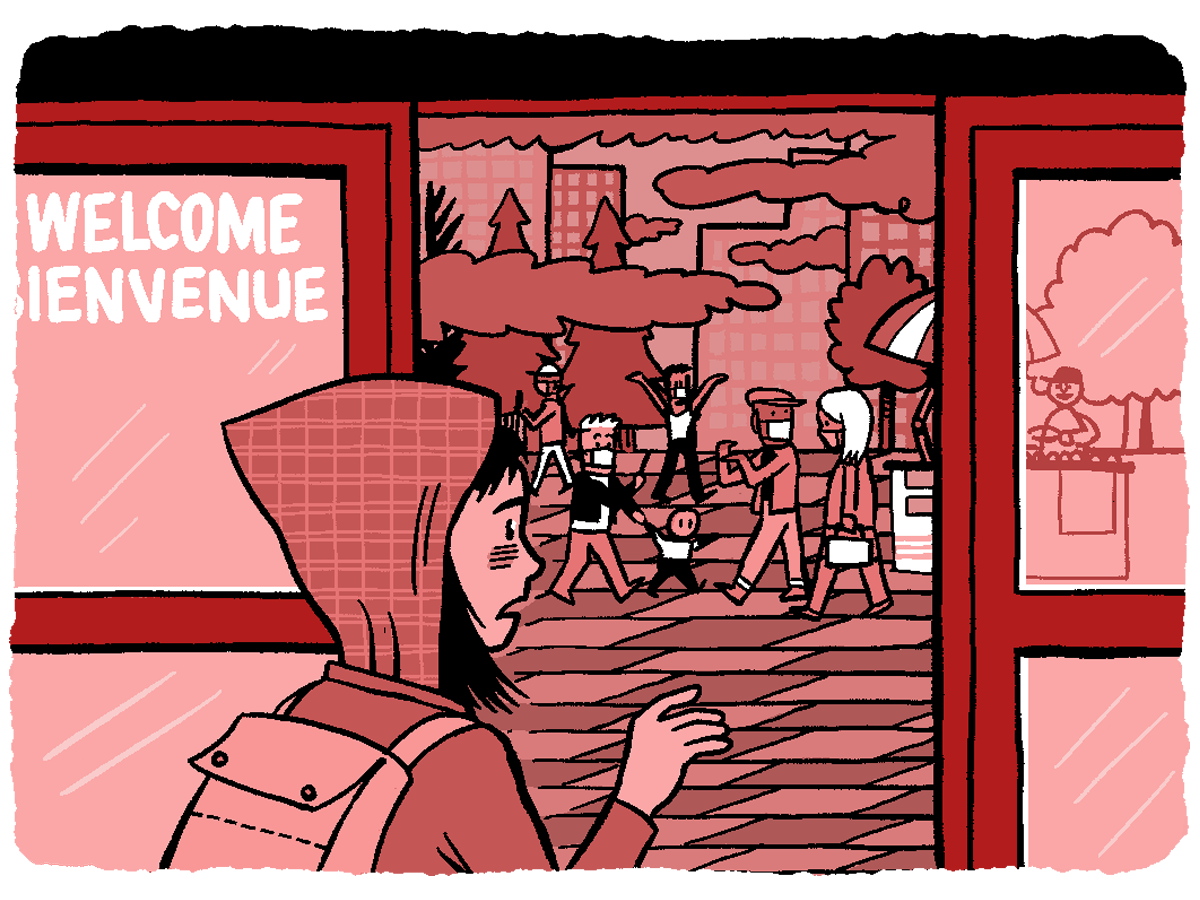
It's a shared building, so it's silly to expect anything on the other side except more of the same—the wildfire smoke, the haze, the heavy amber light. But it is quieter on this side, she realizes as she reaches the end of the hallway and the double doors swish open to let her outside. And there are more trees, dusty-looking spruce and pine arranged on either side of the walkway like a guard of honour. There's a food stand decked with fake flowers, offering something she cannot recognize (what are doubles?). There's a road, cars, signage in a dozen languages, a taxi stand, ranks of bicycles to rent, a souvenir shop crammed with toy moose and mysterious glass bottles.
And in the distance, there are wide open skies.
Premee Mohamed is a Nebula, World Fantasy, Ignyte, Locus, and Aurora award-winning Indo-Caribbean scientist and speculative fiction author based in Edmonton, Alberta. She has also been a finalist for the Hugo, British Fantasy, British Science Fiction, Ursula K. Le Guin, and Crawford awards. In 2024, she was the Edmonton Public Library writer-in-residence, and she has taught at establishments including the Banff Institute for the Arts, the Clarion Workshop, and the Carl Brandon Society.
Illustrations by Eric Dyck
Eric Dyck is a Lethbridge-based cartoonist and art educator. He has shared his love of cartoons and comic-storytelling in art galleries, museums, schools and libraries throughout Alberta and New Brunswick. Eric has been documenting his experiences and adventures in Southern Alberta through his webcomic, Slaughterhouse Slough. Find out more at ericdyck.com.
A note from Forward Weekly on opinion content: The opinions expressed in this feature article are solely those of the author and do not necessarily reflect the views of Forward Weekly or its publisher, editors, staff, or affiliates.